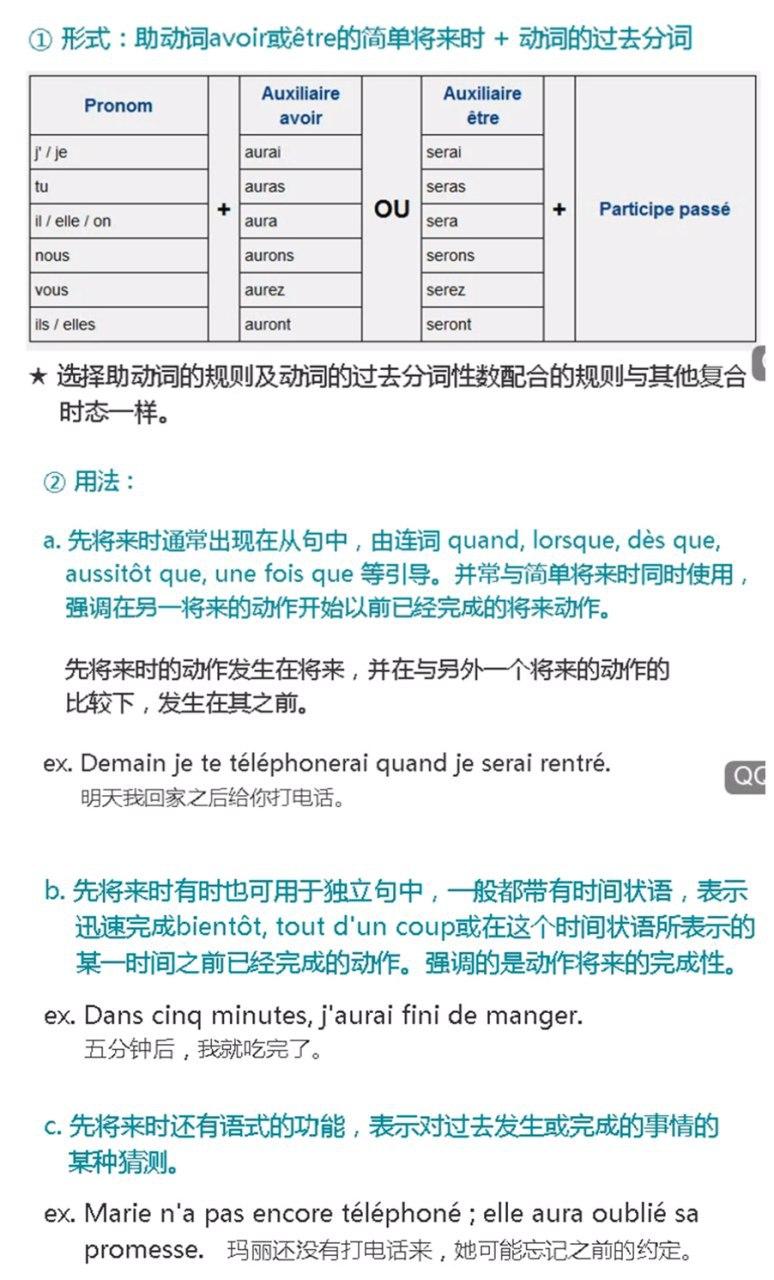
Le futur antérieur (先将来时) 用法
1. Formation(形式)
The future perfect (futur antérieur) is formed with the simple future of the auxiliary (either être or avoir), plus the past participle of the main verb. The choice between être and avoir as an auxiliary is the same as in the passé composé. (助动词的简单将来时形式后跟动词的过去分词)
Future perfect = auxiliary in the future + past participle of main verb
finir 'to finish'
j'aurai fini, nous aurons fini,
I will have finished we will have finished
tu auras fini, vous aurez fini,
you will have finished you will have finished
il, elle / on aura fini, ils / elles auront fini,
he, she (it) / one will they will have finished
have finished
partir 'to leave'
je serai parti(e), nous serons parti(e)s,
I will have left we will have left
tu seras parti(e), vous serez parti(e)(s),
you will have left you will have left
il, elle / on sera parti(e), ils / elles seront parti(e)s,
he, she (it) / one will they will have left
have left
Note that with the auxiliary être, the past participle agrees in number
and gender with the subject.
2. usage(用法)
The futur antérieur is used for an action that precedes, or will be
completed before, another action in the future. While the futur is
expressed in English by 'will' + main verb (will finish), the futur
antérieur is usually translated as 'will have' + past participle of verb
(will have finished). For example:
先将来时表示一个动作发生在另一个将来动作之前。
(类似于英语中的将来完成时will have + 过去分词结构)
Corey et Joe-Bob n'auront pas appris le futur antérieur avant la fin du
semestre.
Corey and Joe-Bob will not have learned the future perfect before the end
of the semester.
Negation is formed as usual by placing ne / n' ... pas around the
conjugated verb, which in this case is the auxiliary:
Corey et Joe-Bob n'auront certainement pas compris le futur antérieur
avant la fin du semestre.
Corey and Joe-Bob will not have understood the future perfect before the
end of the semester.
3. conjunctions(连词)
The futur antérieur is used similarly in French and English. However,
French uses the future perfect after certain conjunctions like quand and
lorsque (when) or dès que and aussit?t que (as soon as) where English
would use the present tense.
(一些固定连词后用先将来时:quand, lorsque, dès que和aussit?t que等)
Quand Tammy aura re?u son dipl?me,Tex et elle iront en France.
When Tammy gets her degree, she and Tex go to France.
Dès que Tex et Tammy se seront mariés, ils auront beaucoup de petits
tatous.
As soon as Tex and Tammy get married, they will have lots of little
armadillos.
In the examples above, the subordinate clauses starting with quand and
dès que are in the future perfect because the action of the subordinate
clause will be performed prior to the action in the main clause.
对话
Listen to the dialogue:
Tex et Tammy sont à une soirée. Ils se disputent.
Tex and Tammy are at a party. They are having a quarrel.
Tammy: Tex, quand tu auras fini de draguer toutes mes copines, je voudrais
te dire deux mots!
Tammy: Tex, when you're done hitting on all my girl-friends, I would like
to have a word with you!
Tex: Tammy, on parlera dès que tu te seras calmée!
Tex: Tammy, we'll talk when you've calmed down!
Tammy: Tu es insupportable! Je ne partirai que lorsque tu te seras excusé!
Tammy: You are unbearable! I will not leave until you've apologized!
Tex: Mais je m'amuse bien! On parlera de tout ?a quand la soirée sera
terminée.
Tex: But I am having fun! We'll talk about all this when the party is
over.
Tammy: Quand tu auras bien bu, ce sera trop tard.
Tammy: When you have drunk too much, it will be too late.
Tex: Bon, d'accord, je viens.
Tex: OK, I am coming.
练习
Give the 'futur antérieur' of the verb indicated in parentheses.
1. Tammy : Je travaillerai quand vous ____________. (partir)
2. Tammy : J'espère que Tex ______________ à Edouard. (téléphoner)
3. Tex : Dans quelques années, je __________ un poète célèbre. (devenir)
4. Tammy : Quand Tex et Edouard __________, on pourra manger. (rentrer)
5. Tammy : L'an prochain, les bébés de Rita ____________. (grandir)
6. Tammy : Demain, Tex ___________ ses promesses. (oublier)
7. Tex : J'espère que Tammy __________ son examen. (réussir)
8. Tammy : Quand j' ___________ des enfants, je ressemblerai à Rita. (avoir)
9. Joe-Bob: Quand est-ce que vous ___________ ? (finir)
10. Tammy : J'espère que Tex ____________ une bonne journée. (passer)
11. Tex : Dans une semaine, on ____________ les cours. (terminer)
12. Tex : Tammy, l'an prochain tu m'_______ depuis 5 ans. (conna?tre)